
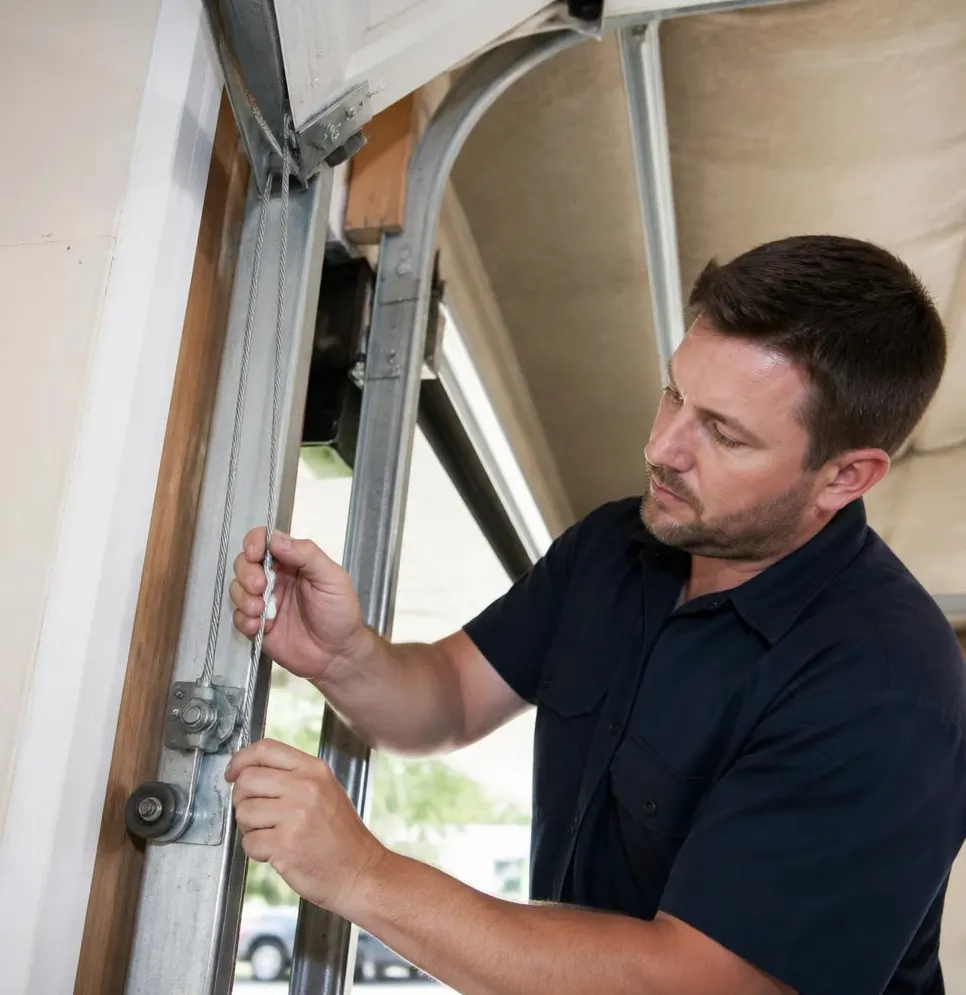
What a Technician Sees After a Wind Event
After a bad nor'easter rolls through Putnam County, the calls we get usually sound the same: a door that's visibly bowed outward in the middle, horizontal tracks pulled away from the wall studs, a torsion spring stretched past its normal arc, or an opener motor that burned out trying to force a door that wind pressure had already jammed. Sometimes it's simpler but just as telling — a homeowner finds rust already forming on the tracks because road salt and slush got tracked in during the last storm and never fully dried out. None of this is random. The garage door is almost always the largest moving opening in a home's exterior wall, and on a lot of the older housing stock in this area, it's also the weakest one.
Why the Garage Door Is the Weakest Wall in the House
A standard double garage door has far more surface area than any door or window on the house, which means it catches far more wind load. When a gust hits a solid wall, the pressure spreads out and the structure resists it. When that same gust hits a garage door, the force concentrates on a few rollers, hinges, and a track system that was often built for convenience, not wind resistance — especially on original doors that have been in place for decades.
Here's the part most homeowners don't expect: it's not just about the door buckling inward from direct wind. If a garage door fails and blows open or collapses during a storm, wind can rush into the garage and push outward on the roof and walls from the inside, which is a major cause of structural damage in severe wind events. A door that looks fine on a calm day can still be the reason a storm does more damage than it should have.
Pre-Storm Checklist for Late Fall Into Winter
With nor'easters and high-wind systems becoming more frequent as we head into winter, now is the time to go over the door before the first major storm, not after.
- Check track-to-wall connections. Vertical tracks are bolted to the wall framing. On older installations, those lag bolts loosen over the years from normal vibration. A technician checking torque on these connections is one of the fastest ways to prevent a track from pulling loose under pressure.
- Inspect panels for existing damage. Dents, hairline cracks, or warping from past storms weaken the door's overall rigidity. A panel that's already compromised is far more likely to fail completely in the next high-wind event.
- Test the hinges and rollers. Stiff, rusted, or loose hinges change how evenly a door distributes wind pressure across its surface. If one section is working harder than the rest, that's where failure starts.
- Look at weatherstripping and seals. Beyond keeping out cold air, intact seals reduce the amount of wind that can get a grip on the bottom edge of the door and start working it loose.
- Consider a bracing kit for wide doors. Horizontal reinforcement struts, which generally run in the $100–$300 range as a national price range, can meaningfully increase a double-wide door's resistance to wind pressure without replacing the whole unit.
- Add battery backup to the opener. Nor'easters routinely knock out power across Putnam County and the surrounding towns. A battery backup means you can still open the door manually or electrically if you need to get a vehicle out during an outage.
If You're Due for a New Door Anyway
If the door is original to the house and already showing its age, a storm season is a reasonable time to ask about wind-rated or reinforced garage door installation options instead of just patching the existing one. The upfront cost is higher than a repair, but for homes that take the brunt of open wind exposure, it's often the difference between a door that holds and one that doesn't.
Why Winter in This Area Makes It Worse
It's not only the wind. Freeze-thaw cycles are hard on garage door hardware. Moisture gets into small cracks in tracks, hinges, and panel seams during a thaw, then expands when it refreezes, gradually working connections loose. Road salt carried in on tires and boots accelerates rust on tracks and springs. A spring that's already corroded or fatigued from age is far more likely to snap under the added strain of a storm, often at the worst possible moment — mid-storm, with the power out, and the door stuck halfway.
When to Call Brewster Garage Door Service
If you've been through a wind event and noticed bowing, a door that's suddenly harder to open, a track pulled away from the wall, or a spring that looks stretched or frayed, that's not a wait-and-see situation. Our Emergency Garage Door Service handles exactly this kind of storm damage, getting the door secured and functional again quickly so your home isn't left exposed before the next system moves through. If the inspection turns up an aging door that's simply not built to handle the wind this area gets, we'll walk you through Garage Door Installation options that hold up better long-term, along with spring replacement or maintenance for doors that just need reinforcement rather than full replacement.
If you're in Brewster, Carmel, Patterson, Southeast, Pawling, Mahopac, Danbury, or New Fairfield and want your garage door checked before the next nor'easter rolls through, give Brewster Garage Door Service a call. We'll look at the hardware, the panels, and the track connections, and tell you straight whether you need a repair, a reinforcement, or a new door — no guesswork, no upsell.